
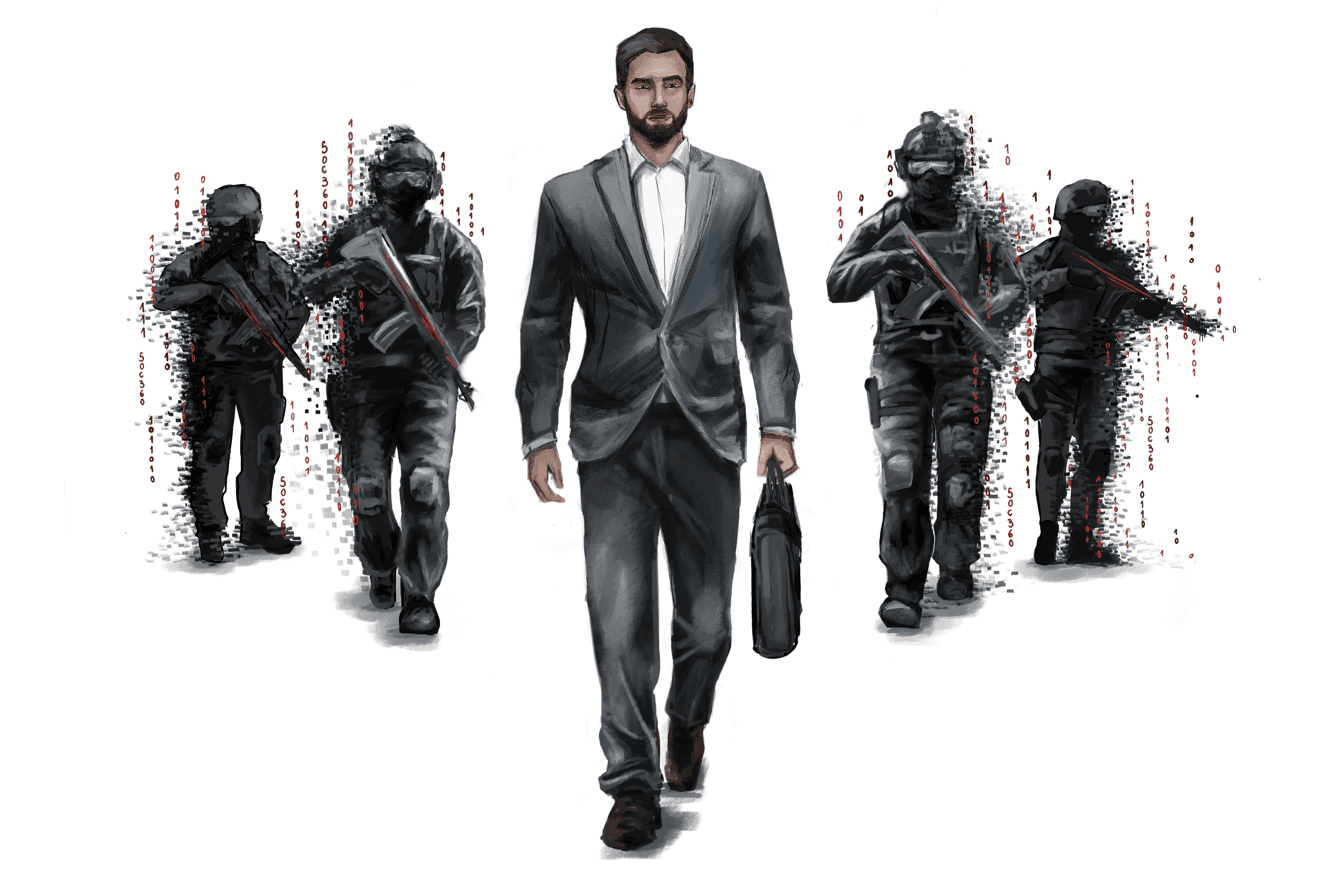
TL;DR
We guarantee loyalty and full transparency. We'll keep your infrastructure secure and make your current security and IT team stronger. Our method of operation removes needless obstacles to communication, offering direct access to professionals and a round-the-clock response. The principles that underpin our collaboration are as follows:
- Our model is one-tiered. Each analyst has been certified to possess both offensive and defensive capabilities.
- We take a proactive approach. Every indication of suspicious activity is examined. Our operations are not restricted to predetermined scenarios. Threats are identified and eliminated at an early stage.
- We work directly on EDR/XDR, NDR, Identity Protection, and SIEM systems.
- We do monitoring, analysis, and responding to incidents. Full scope. 24 hours a day.
- We promise full tactical and operational support, starting with the alert and continuing through careful analysis and a focused, immediate response.
- You are equipped with sophisticated operational capabilities in the following areas: DFIR, CTI, ASM, audits, Threat Hunting, Detection Engineering, and the implementation, support, and integration of cybersecurity systems.
- We work on customer systems or install state-of-the-art systems in the monitored environment.
- We monitor more than 200,000 endpoints and identities in dozens of organizations worldwide. As a result, our people have real-world experience that is enhanced daily by their interactions on the cyber battlefield.
- We possess exceptional expertise in a variety of systems, including Microsoft XDR, Elastic Security, Greycortex, Fidelis Security, DarkTrace, SentinelOne, and others. We make heavy use of these tools and been doing this for a long time
- We value collaboration in a hybrid model that includes open channels on instant messengers, full disclosure of all processes, tools, and technologies, sharing of knowledge through workshops and training, and full technical support for all systems.
- We are adaptable with regard to the range of services and tools we offer, integration, access and authorization, and contact and escalation routes. We can work with any company.
Our customers can focus on their mission because we're here for them 24 hours a day.
SOC360's unique approach
SOC360 employs APIs to monitor cybersecurity solutions, including the Microsoft Security portal, XDR, EDR, NDR, and SIEM systems, for alerts. As soon as a new alert comes in, the incident management system automatically creates a ticket that includes alert artifacts. The system determines if similar alerts have happened before and if the team has already examined them. The ticket is subsequently transmitted to SOC360 analysts, who commence a comprehensive alert analysis.
In order to conduct a comprehensive analysis, SOC360 analysts establish a direct connection to the console of the system that generated the alert. During the analysis, they answer the following questions: What is it? Does it pose a threat? Where does it come from? What is the scope of the event? Among other things, the analysis process entails looking at the telemetry shown in the system console, confirming the information gathered from IT and OSINT sources, pivoting, downloading and examining questionable files, monitoring emails, examining user behavior, conducting research, and cross-checking information in other systems. Upon completion of each analysis, a verdict is rendered: incident or false alarm. A predetermined taxonomy is implemented to categorize incidents. In accordance with established communication methods, the customer is promptly informed of all information and conclusions that are recorded in the incident management system.
- In the event that an incident is identified, the SOC360 team implements IR measures (e.g., process termination, file quarantine, host isolation, user session termination, forced user logout, account lockout, sender/email domain blacklisting) in accordance with the assigned permissions, authorizations, and procedures. Regardless of the actions taken, we will inform the customer of the incident in accordance with the established communication channels (email, phone, Teams, Slack, customer ticketing system). We implement DFIR measures in appropriate situations to ascertain the attack vector, attackers' TTPs, patient zero, potential data leaks, and other relevant factors.
The customer is provided with a comprehensive report upon the resolution of the incident.
To lessen the likelihood of similar alerts in the future, the SOC360 team investigates the possibility of altering the system configuration (adding an exception to the detection rules, changing the detection rules, whitelisting email senders/domains, applications) when the analysis reveals that the alert is a false alarm. This is a key part of SOC360 services, which make security systems work better and usually take the place of automated alert handling.
SIEM systems are installed when necessary. Customizations are made to the SIEM system during the service to improve security. This does not affect the ability to keep an eye on security and handle incidents, though.
It takes a very skilled team organized in a single-line model that doesn't need detailed scenarios to do its work with this method. Because of this, SOC360's whole team of analysts, who operate without being categorized into tiers, maintain a high level of competence.
Implementation of the SOC360 service
SOC360 can begin operations practically immediately after the contract is signed. The process of implementation includes fully connecting the SOC360 platform to the monitored security systems of the customer. During this phase, an audit of the current systems' configuration is conducted to evaluate their state and adherence to security best practices. Simultaneously, the effective monitoring and response are enhanced by the initial system tuning, which is conducted to minimize the number of false alarms.
Setting up rules for operational cooperation is a key part of putting the plan into action. For SOC360 to respond to incidents on its own, this entails establishing authorization levels, creating incident escalation pathways, and specifying contact points. In this way, the system can be perfectly adjusted to fit the needs of the organization.
The SOC team learns about the customer's IT environment architecture, including its specifics, priorities, and potential weaknesses, through workshops that are an essential component of the implementation. Customers can learn about SOC360's processes and tools during the workshops. This method lets the service better fit the specific needs of each customer and makes sure that the protection is as strong as it can be.
Unique advantages of SOC360
SOC360 operates in a modern organizational model without division into tiers. Our team members all have the highest level of skill, which is why we can promise our customers:
Reduced response time: Security threats are addressed in a single-line model as soon as they are discovered, without the delays that come from escalation through multiple SOC lines. This lessens possible damage and drastically cuts down on reaction time;
Efficiency enhancement: Time and resources are not squandered on superfluous escalation procedures. By avoiding these processes, the single tier model enables analysts to react to threats directly;
Better sharing of information: With the single-line model, everyone on the team is involved in protecting against a wider range of threats. This helps everyone learn new skills and share information more effectively. It enables us to enhance our communication with customers and preserve situational awareness.
Consistent readiness: In contrast to the conventional model, which may be constrained by scheduling, the single-line model guarantees our clients a consistent level of preparedness to undertake intricate tasks at any given moment.
The team at SOC360 is made up of highly qualified individuals. Every one of our analysts has acquired practical experience through the analysis and response to thousands of incidents, as well as knowledge of offensive and defensive security.
The team works around the clock in a secure room with dedicated workstations and jump hosts. Our network is protected by state-of-the-art technologies and constantly monitored.
We designate an Incident Response (IR) team to manage large-scale, critical, or complex incidents in order to guarantee sufficient resources and a single point of contact.
We share our knowledge. We provide operational training and training for those responsible for security on the client side. Training covers: processes and procedures, use of tools, cooperation with the SOC360 team. Our services work well in a hybrid model.
We collaborate with our clients to customize SOC360 operational procedures to the specific requirements of their organization, taking into account the organization's mission, security policies, escalation paths, incident context, and systems.
Currently, SOC360 has 40 analysts on staff as of Q4 2025. Each operational analyst has a recognized certification in both offensive and defensive cybersecurity, which validates and continuously develops the team's competencies.